Inspired Research (IR) represents
my research and intellectual property:
-
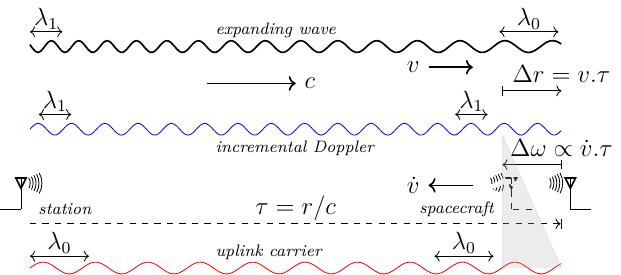
Translationally variant wave solutions presenting
expanding alias signals (or contracting).
Their existence makes relativistic expansion mathematically redundant.
The expansion results in speed increasing (or decreases) with travel,
which contradicts the speed postulate.
They are rigorous solutions to the wave equation,
and thereby to Maxwell's equations, however.
They caused anomalies repeatedly in phase locked tracking of Earth flybys
by both NASA and ESA.
White paper.
Outline and where we stand.
Draft paper
treating mathematics and evidence.
- Status
-
- Theoretic features, capabilities
-
-
Continuous, instant, passive ranging of sources.
-
Source separation by direction and distance, unlimited spectrum reuse.
-
Absolute immunity to interference, jamming short of directed energy.
- Recent papers, reports
-
-
Comment on
..gravitational-magnetic field induced frame-dragging.. (MNRAS).
-
IEEE NAECON 2019
Conclusive analysis and cause of the flyby anomaly
(slides).
-
EPL 2015
Observational evidence for travelling wave modes bearing distance proportional shifts.
-
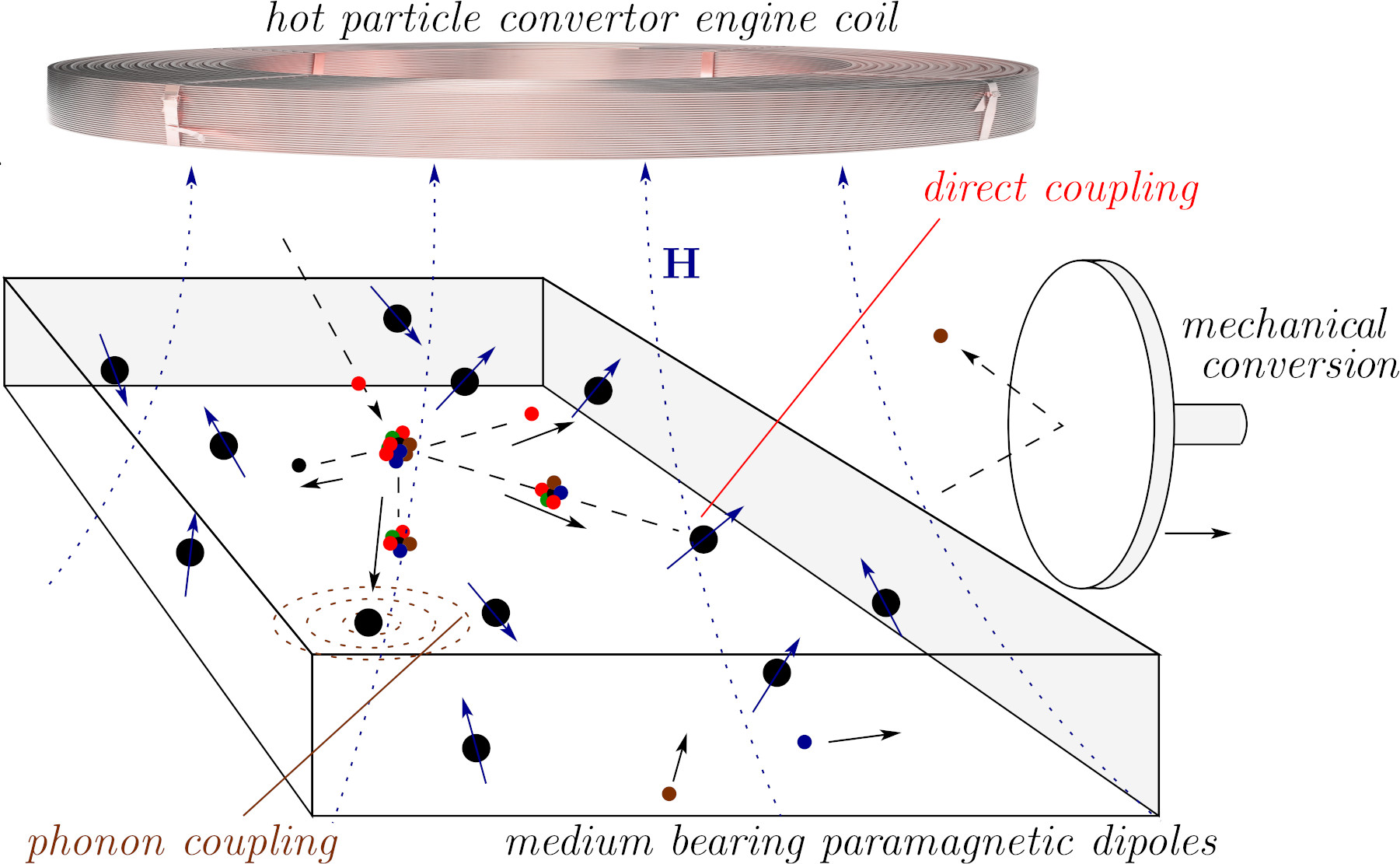
Synchronous, coherent direct conversion of heat.
Inductive coupling between charged or magnetic particles and a load circuit
in principle allows molecular thermal action on the particles to perform work on the load.
-
-
Obviates dependence on macroscopic thermal states, quasi-static operation for cycles.
-
Enables conversion of nascent/hot particle energies competing with heat dispersion.
-
Raises efficiency bound to 99.999% or better.
- Challenges
-
-
Dynamical coupling: thermal impacts → dipole rotations.
-
Dipole implant density
↔ thermal mass
↔ phonon degradation.
- Applicability
-
-
Regenerative recovery of dissipation in computers.
-
Chemical, nuclear power supplies.
- Papers
-

